
Garage Floor Moisture Testing: What Gets Measured and What It Means
Epoxy Floors Base Escondido walks through how a concrete garage slab is checked for moisture, from the signs visible to the eye to the two standard tests, and what a high reading changes about the plan.
Bookings aren't open yet. Leave your name and number; your message is recorded, and you'll get one message when a local installer is available.
The floor as it starts
 Illustration
The finished floor (illustration)
 Illustration
How a coating gets pushed off
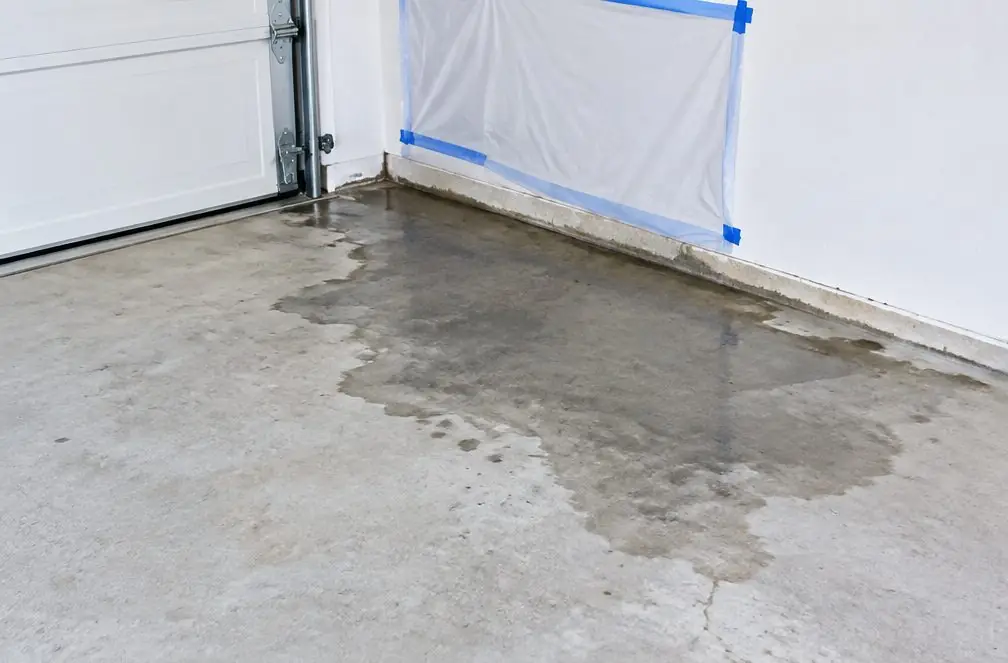
A slab with moisture vapor coming up through it can push a coating off. Concrete is porous, the ground below and beside it holds water, and an older slab may have no vapor barrier at all. Escondido summers are dry, but dry air above a slab says little about the dampness in it.
Signs worth noting first
| What is seen | What it may point to |
|---|---|
| White powder or crust on the surface | Mineral salts carried up by water |
| Dark patches that come and go | Seasonal dampness, a nearby sprinkler or a downspout |
| Old paint bubbling in one zone | Vapor pushing from below, or a bonding problem |
| A musty smell near a wall | Moisture at the stem wall or footing |
Signs prompt a test; they do not replace one.
Test one, calcium chloride (ASTM F1869)
A dish of calcium chloride is weighed, sealed under a dome on the bare, ground slab and left for a few days. The weight gained is converted into a moisture vapor emission rate. It measures what leaves the surface during the test, so it is sensitive to the conditions in the garage during those days.
Test two, in-slab humidity (ASTM F2170)
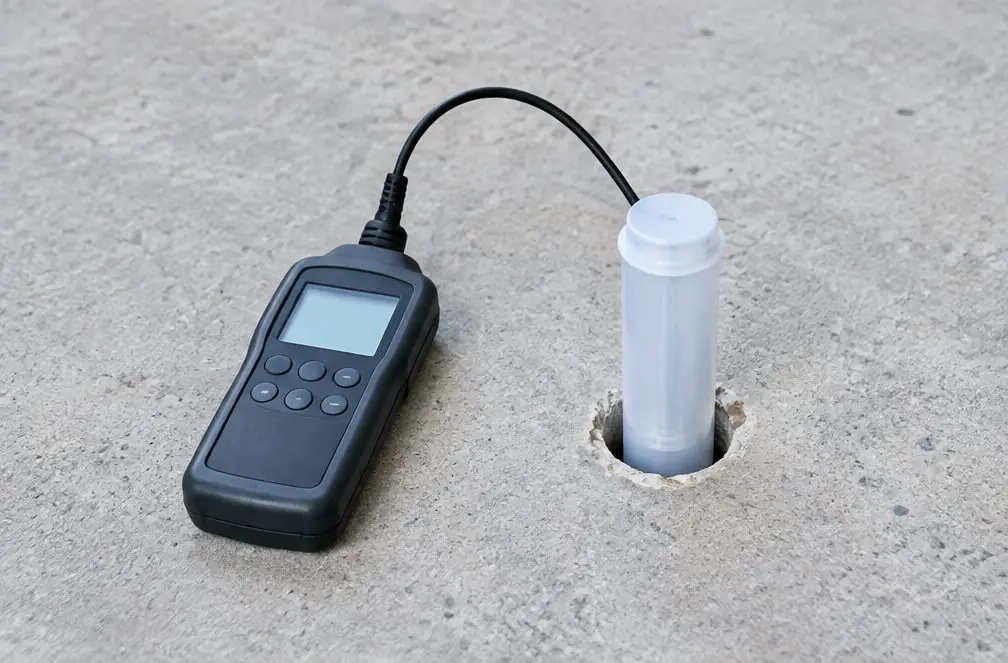
Holes are drilled partway into the slab, sleeved and capped, and left to settle. A probe then reads the relative humidity inside the concrete. Because it reads at depth, it can catch moisture that a surface test misses. Both results are compared with the limits printed on the coating's data sheet.
What a reading changes
Many installers test before coating. Where readings are high, a moisture-mitigating primer is used or the job is reconsidered.
| Result | Typical response |
|---|---|
| Under the data-sheet limit | Coat as planned |
| Over the limit | A moisture-mitigating primer, listed as its own line |
| Far over, or water entering at an edge | Find the source first; the coating waits |
Older slabs and old coatings
Escondido has older central neighborhoods next to newer hillside subdivisions, and a third-party Census tabulation puts about half of the city's homes as built several decades back. An older garage can carry a layered history of paint and sealer, and testing is easiest on a surface that has been ground. In older garages, old vinyl floor tile and black adhesive (cutback mastic) can contain asbestos; it is tested before any grinding or removal, and asbestos work is done only by contractors registered for it.
Questions to ask about testing
- Which method was used, and how many spots on the slab?
- Where are the readings, in writing, and what limit do they meet?
- If the readings are high, what changes in the system and in the price?
- How is dust handled during grinding?
Where this leads
- Service page: Garage Floor Prep and Crack Repair — What the concrete needs before any coating: profile, crack work and moisture testing, step by step.
- Local page: Epoxy garage floors in Downtown Escondido
- All services and typical prices: Epoxy garage floors in Escondido
- More illustrated guides: Epoxy Floor Guides
Check availability and the price range for this setup
Bookings aren't open yet — a typical Escondido range in about 30 seconds.