
Commercial Kitchen Flooring in Escondido
Epoxy Floors Base Escondido covers commercial kitchen and restaurant flooring in Escondido — hot-water washdowns, a coved base, floor drains and the San Diego County environmental health review that follows a remodel — and says when urethane cement outperforms epoxy.

Bookings aren't open yet. Leave your name and number; your message is recorded, and you'll get one message when a local installer is available.
 Illustration
What a food facility floor must be
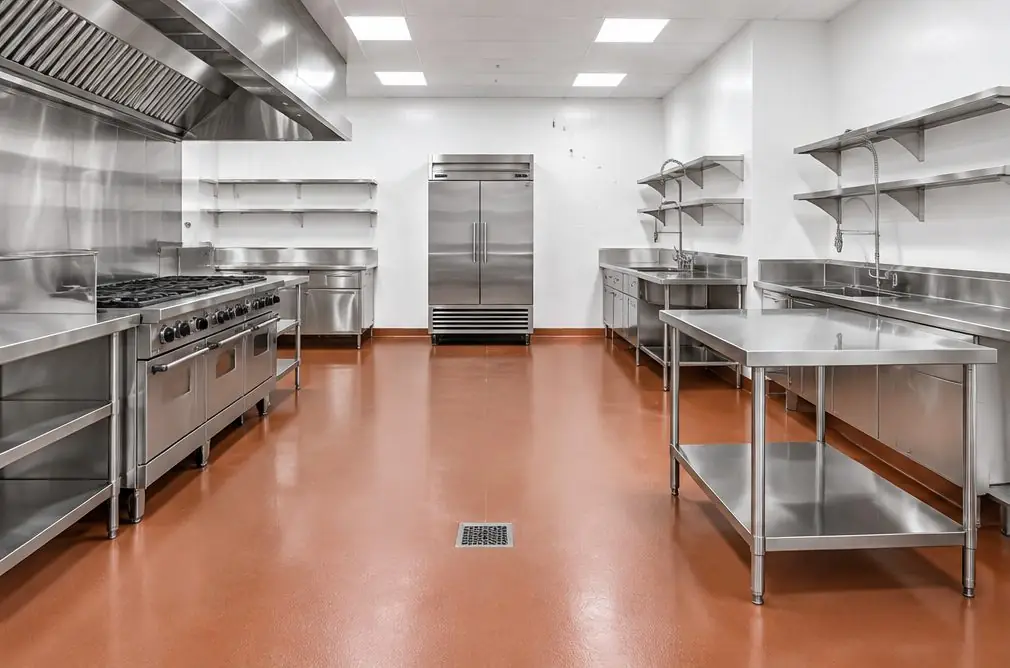
In California, floors in food facilities must be smooth, durable, nonabsorbent and easily cleanable, with a coved base where floor meets wall (California Retail Food Code, Health and Safety Code §114268). A seamless resinous floor with a cove and no open joints fits that description. Federal agencies do not approve flooring products, so no coating can claim an approval; the county reviews the plans and inspects the facility.
Urethane cement against standard epoxy
| Urethane cement | Standard epoxy | |
|---|---|---|
| Heat and washdown | Tolerates hot-water cleaning and thermal shock | Can soften or crack under repeated steam and hot water |
| Build | Thick, troweled | Thin, rolled film |
| Slab moisture | Tolerates damp concrete better | Wants a dry slab |
| Odor and return | Low odor, returns to service quickly | Odor depends on the product |
| Cost | $8–$16 per sq ft | $4–$8 per sq ft with flake, up to $11 in quartz |
| Best for | Wash lines, walk-in coolers, dish rooms | Dry prep areas, dining rooms, back corridors |
Kitchens with hot-water washdowns often use urethane cement systems, which tolerate heat and thermal shock better than standard epoxy.
What the numbers show
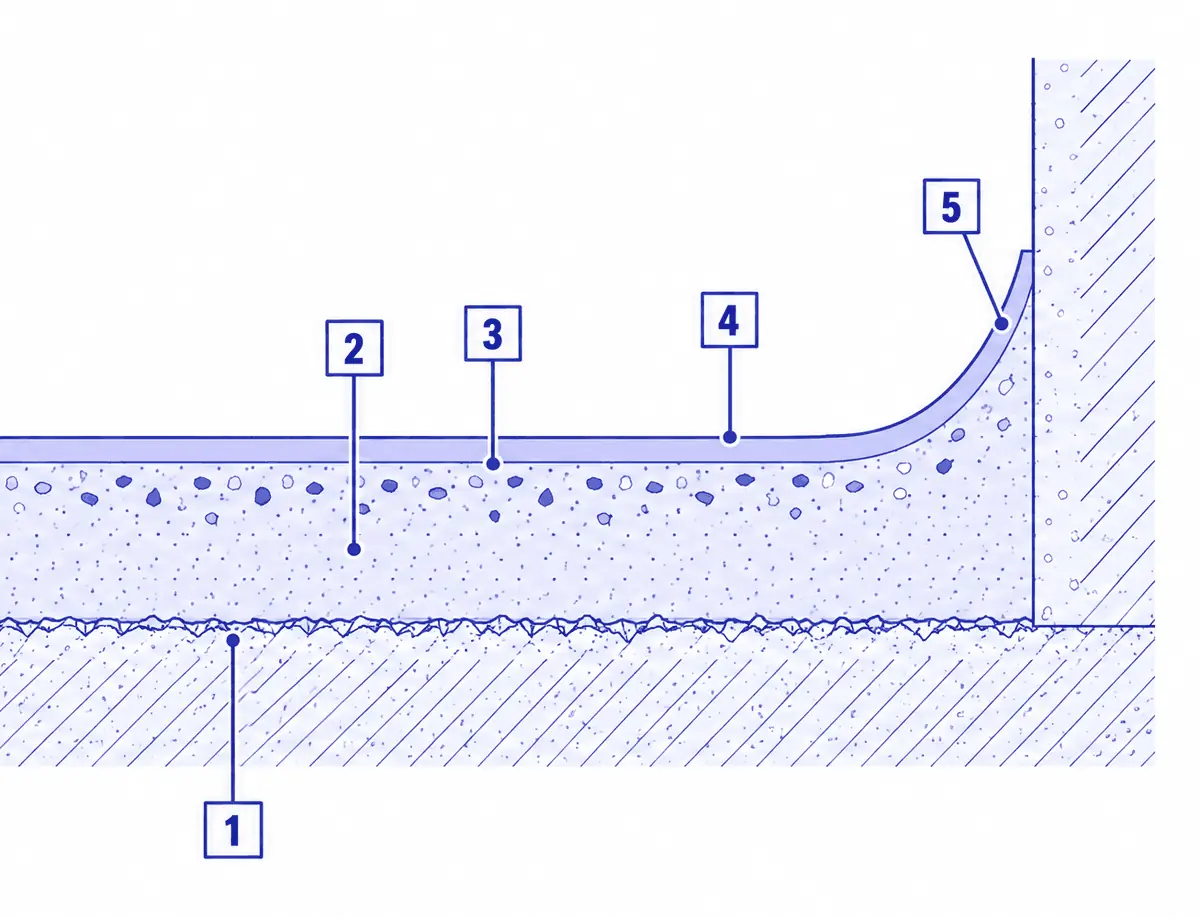
- Prepared slab Shot-blasted or ground so the troweled layer can grip; moisture is tested first.
- Urethane cement body A thick, troweled layer that tolerates hot-water washdowns and thermal shock better than standard epoxy.
- Broadcast aggregate Colored aggregate scattered into the top of the layer for texture underfoot.
- Sealer A thin top layer that closes the surface so it can be cleaned.
- Coved base The system sweeps up the wall in one radius; California's food code asks for a coved base where floor meets wall.
Cove, slope and drains
A coved base curves the floor up the wall so no seam is left to hold grease. It is priced at roughly $8–$22 per linear foot, or $800–$2,200 for about 100 feet. Slope toward a drain and the drain itself are plumbing and building work outside the coating; the floor system has to stay tight at the drain edge, and the slope is set before the coating arrives.
San Diego County's plan check
The County of San Diego Department of Environmental Health and Quality (Food and Housing) reviews plans for new construction and remodels of food establishments, and a plan submittal typically lists the interior finishes in a finish schedule. A change of floor or cove material is a finish-schedule item. Ask the department what it needs before work begins, and ask how long review takes before a closure is planned around it.
Doing a kitchen in phases
A kitchen that closes overnight can often be done in sections: the dish room one weekend, the line the next. Return to foot traffic and carts follows the data sheet, and odor and ventilation are planned for the staff who come back. Fast-cure urethane systems shorten the wait compared with epoxy.
Commercial Kitchen Flooring — common questions
Is there a food-safe or USDA-approved kitchen floor?
No. Federal agencies do not approve flooring; the FDA does not approve flooring, and the old USDA acceptance of building materials ended long ago. The floor must meet the California Retail Food Code, and the county decides in plan check and inspection.
What does a commercial kitchen floor cost in Escondido?
Urethane cement runs about $8–$16 per square foot, with coved base at roughly $8–$22 per linear foot. A 1,200 square foot kitchen with a 100-foot cove lands near $10,400–$21,400. These are market estimates, not quotes.
Commercial Kitchen Flooring: check availability and price range
Bookings aren't open yet — a typical Escondido range in about 30 seconds.