
Epoxy, Polyaspartic or Polyurea: Choosing the Layers for an Escondido Garage
Epoxy Floors Base Escondido treats epoxy, polyaspartic and polyurea as jobs inside one layered garage floor system rather than as rival products, and shows how Escondido heat, sun at the open door and the age of the slab tip the choice.
Bookings aren't open yet. Leave your name and number; your message is recorded, and you'll get one message when a local installer is available.
The floor as it starts
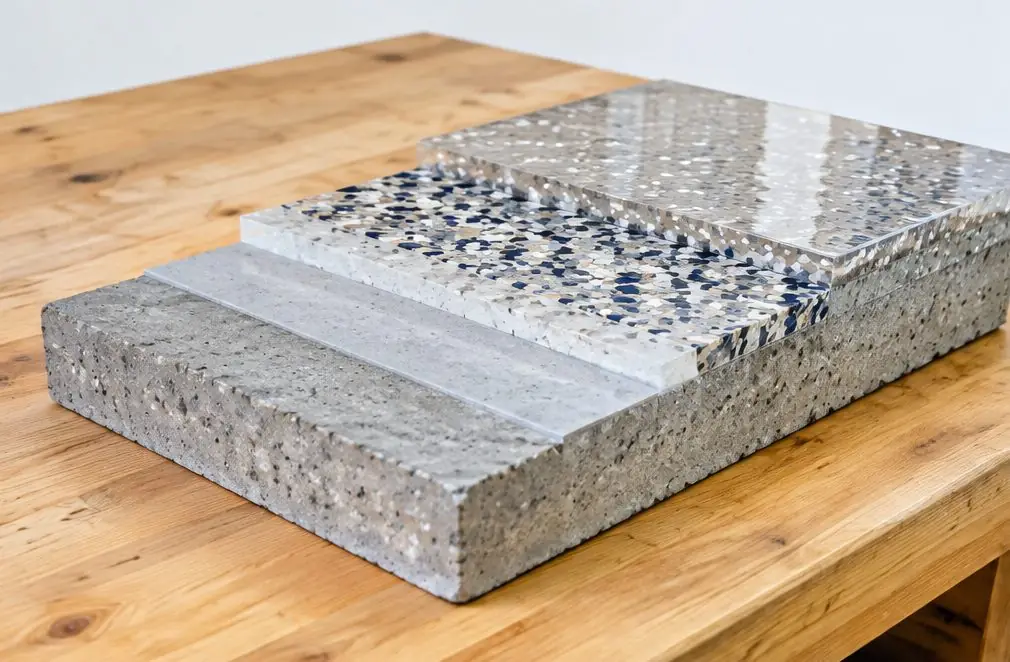 Illustration
The finished floor (illustration)
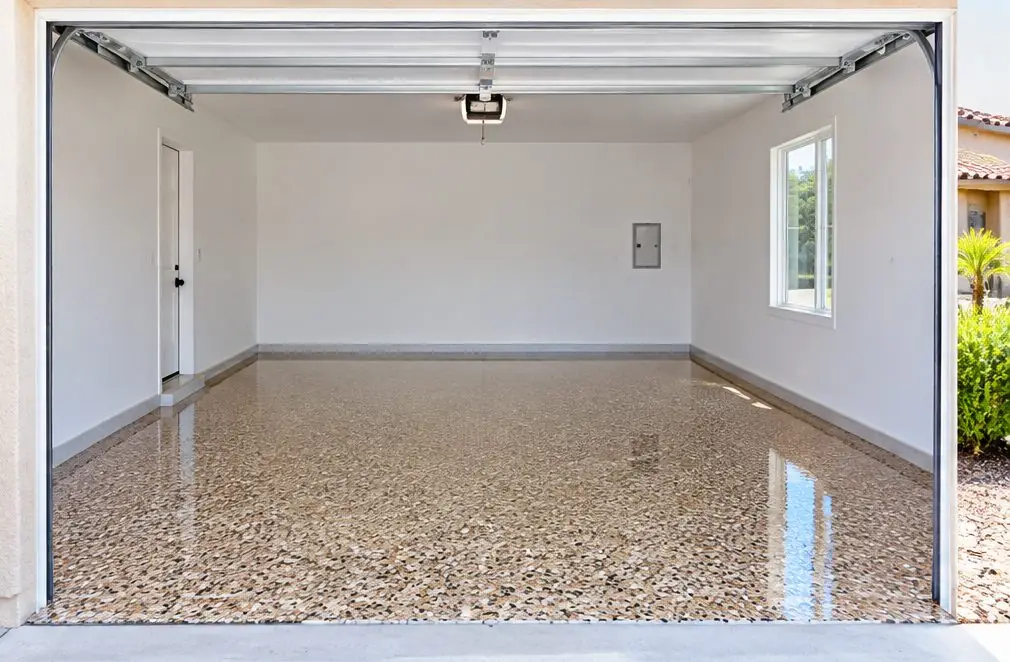 Illustration
One floor, four layers
A garage coating is built in layers, and each chemistry is picked for the job of a layer.
| Layer | Job | Chemistry often used |
|---|---|---|
| Primer | Wets the ground slab and locks in dust and pores | Epoxy or a penetrating primer, per the data sheet |
| Base coat | Color and film build | Pigmented epoxy, which has a long working time |
| Broadcast | Flake or quartz thrown into the wet base | Vinyl flake, colored quartz |
| Top coat | The clear wear and sun layer | Epoxy, polyaspartic, polyurea or polyurethane |
Epoxy is often used as a base coat because it has a longer working time and bonds well to a ground slab. Polyaspartic and polyurea top coats are generally more UV-stable than standard epoxy and cure faster. A "hybrid" is simply an epoxy base under one of those top coats.
Heat sets the schedule
Escondido is an inland valley city. Its long-term mean daily highs run 81.9°F in June, 87.2°F in July, 89.0°F in August and 86.9°F in September, and the all-time record is 115°F. A garage that sat shut in that weather is warm before anyone opens a bucket.
In heat, polyaspartic and other fast-cure products have a short working time, so there is little room to blend wet edges across a wide floor. An installer may start early, keep the door shaded, work in smaller sections or pick a slower-curing product for the base. Heat shortens working time for every two-part coating; the choice is how much margin is wanted.
Sun at the open door
Epoxy can amber (yellow) in sunlight, which matters when the door stays open. An aliphatic polyaspartic or polyurethane top coat is generally more UV-stable, so a west-facing door that takes the afternoon sun points toward one of those on top. A garage with a closed door and a workshop corner has less reason to pay for it.
Which garage leans which way
| Garage | Leaning | Reason |
|---|---|---|
| Older central neighborhood, slab of unknown history | Epoxy base after a moisture test, clear top coat chosen after the readings | Test results decide, not the label |
| Newer hillside subdivision, open door to sun | Epoxy base with a UV-stable top coat | Sun at the door is the main stress |
| Workshop with a closed door | Solid color or flake epoxy, grit as wanted | Little sun, so a UV-stable top matters less |
| Weekend project car | Flake with a UV-stable top, ask about hot-tire pickup | See the hot-tire guide for the prep side |
Older garages in central Escondido
A third-party tabulation of Census data puts the median home in the city as built a few decades back, with about half of the units older than that. Central neighborhoods such as Old Escondido, whose historic district runs from 4th Avenue to 13th Avenue and holds about 900 homes, the oldest dating from the mid-1880s, sit next to newer hillside subdivisions. The district has its own rules for exterior changes; this guide is about the floor inside, and the coating question is the same wherever the garage stands.
Older slabs may carry a past paint, a sealer or an oil stain, and may have no vapor barrier below. That makes the prep and the moisture test more important than the top coat brand.
Questions to ask about the system
- Which chemistry is the primer, the base and the top coat?
- What is the total film thickness in mils, and what does the data sheet list?
- How is working time handled on a hot afternoon?
- Is the top coat UV-stable, and what does the data sheet say?
- Warranty terms are set by the installer and by the coating manufacturer; ask what is covered (peeling, hot-tire pickup, UV yellowing), for how long, and whether the prep is part of it.
Where this leads
- Service page: Flake Epoxy Garage Floor — The classic decorative garage system, with the stack of layers, the broadcast decision and the top coat spelled out.
- Local page: Epoxy garage floors in Old Escondido Historic District
- All services and typical prices: Epoxy garage floors in Escondido
- More illustrated guides: Epoxy Floor Guides
Check availability and the price range for this setup
Bookings aren't open yet — a typical Escondido range in about 30 seconds.